






How to Read Prescription
Before ordering contact lenses or glasses, we recommend that you visit an ophthalmologist or optometrist who will issue a prescription for glasses and/or contact lenses. A prescription for contact lenses and a prescription for glasses are different things – in addition to the difference in the power of glasses and contact lenses, it is also necessary to know other parameters such as base curve (BC) and diameter (Dia) for lenses, and interpupillary distance (PD) for glasses. If you do not have a prescription, you can find the information you need to order contact lenses on the contact lens box. You can find the information you need to order glasses on the receipt for your previous glasses. If you do not have a prescription for lenses, a lens package, or a receipt for your previous glasses, and it has been more than a year since your last eye exam, we recommend that you visit an ophthalmologist or optometrist before making a purchase.
Most contact lens prescriptions look like this (not all boxes may be filled in):
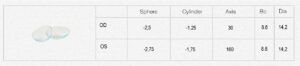
- OD – right eye; OS – left eye
- BC – base curve (the range of values can be 8.0 – 10.0)
- Dia – diameter (the range of values can be 13.0 – 15.0)
- Sph – sphere, power (the range of values can be from +20,0 to -20,0)
- Cyl – cylinder (for toric lenses, the range of values can be from +4,0 to -4,0).
- Axis – axis (for toric lenses, the range of values can be 0°-180°)
- Add – addition (for multifocal lenses, the range of values can be: low, med, high)
You can also check previously purchased contact lenses boxes in order to find out the parameters (Sph=D=PWR).
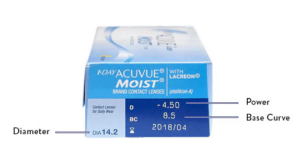
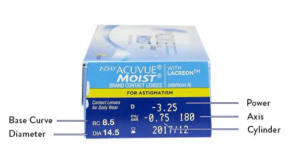
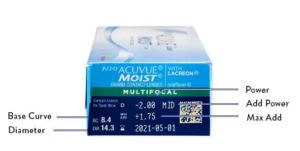
Most prescriptions for glasses look like this (not all boxes may be filled in):
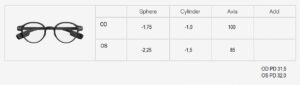
- OD – right eye; OS – left eye
- Sph (sphere/power) – Indicates the strength of the correction, a minus sign indicates nearsightedness and a plus sign indicates farsightedness.
- Cyl (cylinder) – The field is filled in if the patient has astigmatism that requires correction. If this field is not filled in, then there is no astigmatism or it is so small that correction is not required.
- Axis – The field is also filled in for astigmatism and its value ranges from 0°-180°
- Add (addition) – reading addition is used with bifocal or multifocal glasses to indicate the additional power for near vision. It is always a positive value, which is usually the same for both eyes.
- PD (pupillary distance) – the distance between the eyes, which is measured horizontally from the light reflex in the middle of the pupil of the eye to the middle of the bridge of the nose, for both eyes separately. It differs in glasses for distance and near vision. Sometimes PD is written as only one number, then the distance between the eyes from the middle of the bridge of the nose is equal.
— For example: 31.5/32.0 means that the distance from the light reflex of the pupil of the right eye to the middle of the nose is 31.5 mm; the distance from the light reflex of the pupil of the left eye to the middle of the nose is 32.0 mm. For example: 61 means that the distance from the light reflex of the pupils of both eyes to the middle of the nose is 30.5 mm. - The following words may also appear on a prescription:
— Procul – glasses for distance vision
— Prope – glasses for near vision
— Pro Media – glasses for intermediate distance, e.g. for the screen